A relatively unfamiliar substance called 7-OH has rapidly become a growing concern in the United States. Products containing concentrated 7-OH are being sold in forms such as tablets, gummies, drink mixes and shots, often through smoke shops, gas stations, convenience stores and online retailers.
But what exactly is 7-OH, and why are health officials increasingly concerned about it?
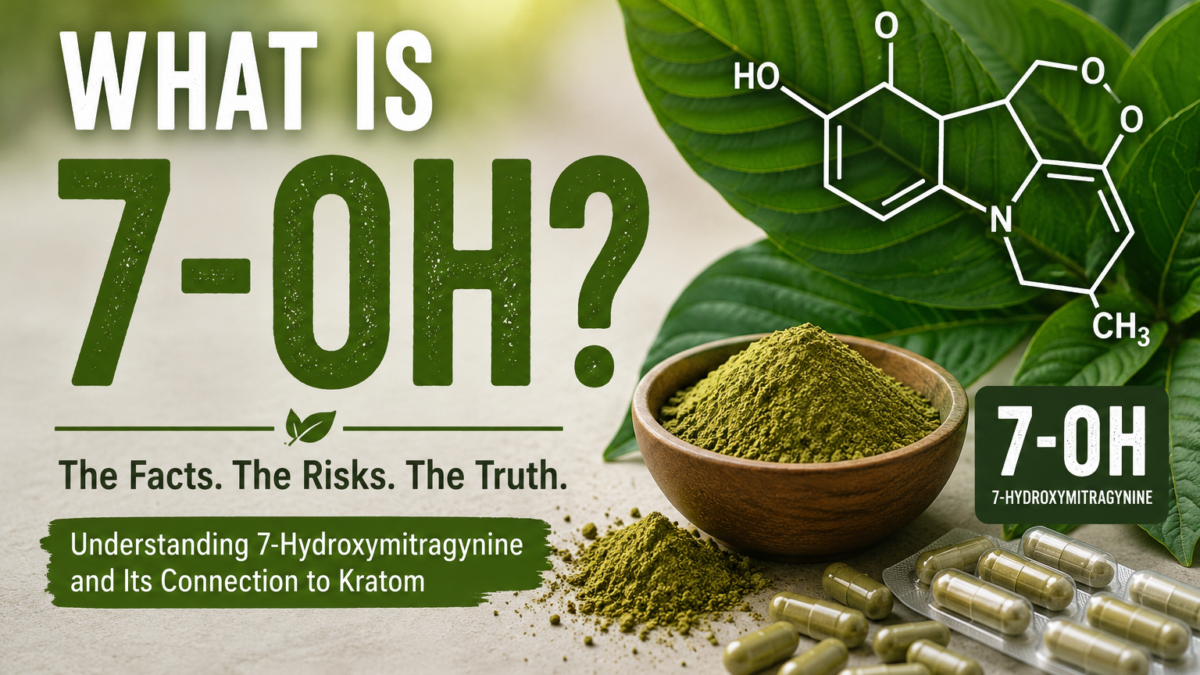
7-OH, short for 7-hydroxymitragynine, is a potent kratom-derived compound with opioid-like activity. Although 7-OH occurs naturally in kratom in very small amounts, concentrated 7-OH products can contain levels far beyond those ordinarily found in the plant.
Reports of addiction, withdrawal and serious adverse effects are mounting. In response, federal regulators have begun taking significant steps against concentrated 7-OH products.
What Is 7-OH?
7-OH is short for 7-hydroxymitragynine (7-OH), an alkaloid associated with the kratom plant (Mitragyna speciosa).
Kratom is native to Southeast Asia and contains numerous naturally occurring compounds called alkaloids. The most abundant and best-known of these is mitragynine. 7-hydroxymitragynine occurs naturally in kratom leaf in much smaller quantities.
Both mitragynine and 7-OH interact with opioid receptors in the brain. However, 7-OH has substantially greater opioid activity than mitragynine.
This distinction has become increasingly important because many of today’s commercial 7-OH products are very different from traditional kratom leaf.
The FDA has specifically distinguished concentrated 7-OH products from natural kratom leaf products, warning that the concentrated products present a much greater concern for abuse and addiction.
How Is 7-OH Derived From Kratom?
7-OH has a close chemical relationship with mitragynine, kratom’s primary alkaloid.
Small amounts of 7-hydroxymitragynine occur naturally in kratom. Mitragynine can also be metabolized into 7-hydroxymitragynine in the human body.
The problem surrounding today’s 7-OH market is the enormous difference between the trace quantities associated with traditional kratom leaf and the concentrated or enhanced 7-OH products now being sold commercially.
Research published in 2026 examining commercial kratom products noted the emergence of hundreds of products containing semisynthetic 7-OH and related compounds. Researchers also found substantial inconsistencies between some product labels and the actual amount of 7-OH detected.
Rather than simply consuming the relatively small amount naturally occurring in kratom, consumers may therefore be exposed to products specifically formulated to deliver much larger amounts of 7-OH.
Why Is 7-OH Dangerous?
The greatest concern surrounding 7-OH is its powerful opioid-like activity.
The FDA describes concentrated 7-OH products as novel potent opioid products and warns that exposure can result in serious harm.
Reported adverse effects associated with 7-OH products include:
- Addiction and physical dependence
- Anxiety
- Depression
- Gastrointestinal distress
- Insomnia
- Seizures
- Withdrawal symptoms
The FDA has also raised broader safety concerns surrounding kratom and kratom-derived products, including reports involving liver toxicity, cardiovascular toxicity, respiratory depression and more. In some cases, however, available evidence cannot determine whether a particular adverse event was caused specifically by 7-OH, mitragynine, another substance or a combination of substances.
This uncertainty is another reason concentrated, inconsistently formulated products are concerning.
7-OH Addiction Is Becoming a Growing Concern
Perhaps one of the most troubling characteristics of 7-OH is its potential to cause dependence and addiction.
Because 7-OH acts on opioid receptors, repeated exposure can result in patterns resembling those associated with other opioid substances. A person may develop tolerance, requiring increasingly frequent or larger amounts to achieve the desired effect.
Physical dependence can then make stopping difficult.
The FDA has specifically received reports of addiction and withdrawal associated with 7-OH products.
This is particularly concerning because a consumer may initially perceive a product as simply another kratom or botanical product without understanding the pharmacological difference between ordinary kratom leaf and a highly concentrated 7-OH formulation.
What Are the Side Effects of 7-OH?
The effects of 7-OH can vary depending on the amount consumed, product concentration, frequency of use, individual physiology and whether other substances are involved.
Reported health concerns include:
- Nausea and gastrointestinal problems
- Anxiety
- Sedation or drowsiness
- Sleep disturbances
- Depression
- Seizures
- Dependence and addiction
Higher-potency opioid-like substances can also present greater concerns when combined with alcohol, sedatives, opioids or other central nervous system depressants.
Another problem is that consumers may not always know exactly how much 7-OH they are receiving. A 2026 scientific analysis of commercially available products found discrepancies between labeled and measured quantities of 7-OH in several products.
What Does 7-OH Withdrawal Feel Like?
Physical dependence can lead to withdrawal when someone who has been regularly consuming 7-OH suddenly stops or substantially reduces use.
The FDA reports withdrawal symptoms associated with 7-OH including:
- Restlessness
- Body aches
- Fatigue
- Irritability
- Cold sweats
Anxiety, insomnia and gastrointestinal symptoms have also been reported in connection with 7-OH use.
Because of its opioid activity, people experiencing significant 7-OH dependence or withdrawal should seek guidance from a qualified healthcare professional rather than assuming the product is harmless because it originated from kratom.
How Widely Available Is 7-OH?
One of the most alarming aspects of the emerging 7-OH problem has been its extraordinary accessibility.
Concentrated products have been sold through:
- Gas stations
- Smoke shops
- Vape shops
- Convenience and corner stores
- Online retailers
Products have appeared as tablets, gummies, candies, drink mixes, shots, powders, syrups, extracts and other consumer-friendly forms.
For consumers, this retail environment can create the impression that a product has been reviewed, approved or determined to be safe.
That is not the case.
The FDA states that there are no FDA-approved drugs containing 7-OH. The agency also says 7-OH is not lawful as a dietary supplement and cannot lawfully be added to conventional foods.
The FDA began issuing warning letters to companies marketing concentrated 7-OH products in 2025.
7-OH Exposures Are Rising Rapidly
Recent Poison Center statistics demonstrate just how quickly the issue is developing.
According to America’s Poison Centers, 593 7-OH exposure cases were reported during all of 2025.
During just the first six months of 2026, Poison Centers had already received 901 reports involving 7-OH.
That means the first half of 2026 alone substantially exceeded the number reported during the entirety of the previous year.
Among cases reporting exposure to 7-OH alone:
- 38.8% experienced serious health problems
- 63.8% were treated at a healthcare facility
- 20.5% were hospitalized
America’s Poison Centers reported that average monthly 7-OH case counts during 2026 represented a 102% increase compared with the average monthly case count during the final six months of 2025.
These statistics demonstrate that 7-OH is no longer merely an obscure kratom derivative. It is becoming a significant emerging substance-use concern.
Federal Regulators Are Now Moving Against Concentrated 7-OH
The regulatory landscape surrounding 7-OH is changing quickly.
In July 2025, the FDA announced that it had sent warning letters to companies marketing products containing 7-OH. Later that month, the agency recommended federal scheduling action targeting concentrated 7-OH.
Developments accelerated further in July 2026.
The DEA announced the beginning of the temporary scheduling process for 7-OH above a proposed specified threshold, along with several synthetic 7-OH derivatives.
The distinction is important: federal officials have emphasized that these actions are aimed at concentrated or enhanced 7-OH and related synthetic compounds, rather than treating ordinary natural kratom leaf as equivalent to concentrated 7-OH.
The situation therefore illustrates an unusual regulatory gap: highly concentrated products became widely available before the regulatory framework had fully caught up with their rapid emergence.
Can an Instant Drug Test Detect 7-OH?
Testing for 7-OH presents another challenge.
There is currently no commonly available instant drug test designed specifically to identify 7-OH as its own standalone drug panel.
Most instant Kratom (KRA) urine tests are designed primarily to detect mitragynine, the major alkaloid associated with kratom. However, this does not necessarily mean that 7-OH use will always escape a kratom screen. Some Kratom instant tests also hold the capability to detect 7-hydroxymitragynine as a byproduct of the initial Kratom screen.
Laboratory information published in 2026 notes that although a kratom immunoassay is not designed to directly detect 7-OH, commercially available 7-OH products also commonly contain mitragynine. Scientific research has also demonstrated that some mitragynine antibodies can exhibit cross-reactivity with 7-hydroxymitragynine.
Therefore, certain Kratom (KRA) tests may potentially indicate exposure associated with some 7-OH products, particularly when mitragynine or other detectable kratom-related compounds are present.
However, a Kratom test should not be interpreted as a dedicated 7-OH test, and a negative Kratom result cannot conclusively establish that someone has not used a concentrated 7-OH product.
When definitive identification of 7-hydroxymitragynine itself is necessary, specialized laboratory testing such as mass-spectrometry-based analysis may be required.
Where Can You Get Instant Kratom Tests?
As emerging substances change the drug-testing landscape, having access to expanded-panel testing options has become increasingly important.
1-Step Detect offers instant Kratom (KRA) urine drug testing options for organizations looking to expand beyond traditional drug panels.
Kratom testing can help identify the presence of the primary kratom alkaloid targeted by the test and may provide useful screening information when kratom or certain 7-OH products are suspected.
Visit 1-Step Detect to explore available Kratom (KRA) drug tests and other expanded drug-testing options.
The Bottom Line: 7-OH Is an Emerging Drug to Watch
7-hydroxymitragynine represents an important example of how rapidly the drug landscape can change.
A compound that occurs naturally in only small quantities in kratom is now being concentrated and sold in powerful consumer products that can have significant opioid-like effects.
The combination of high potency, addiction potential, withdrawal, rapidly increasing Poison Center exposures and widespread retail availability has attracted the attention of federal health and drug-enforcement agencies.
With DEA’s 2026 scheduling process now underway, the era in which concentrated 7-OH products could seemingly proliferate with little federal oversight may be beginning to change.
For drug-testing programs, 7-OH also demonstrates why testing strategies must continue evolving. There is not yet a conventional instant panel specifically dedicated to 7-OH, but Kratom (KRA) testing can provide an important additional screening tool, particularly because many commercial 7-OH products may contain detectable mitragynine.
As new drugs and derivatives emerge, awareness, education and appropriate testing will remain essential.