Screening for Alcohol with Instant Drug Tests: Urine EtG vs. Saliva Alcohol Testing
When people think about instant drug testing, substances such as marijuana, cocaine, methamphetamine, opiates, and fentanyl often come to mind first.
But alcohol can also be incorporated into an instant screening program, and there are two very different ways to do it:
Urine testing for EtG and saliva testing for alcohol.
Although both are intended to provide information about alcohol use, they are not testing for exactly the same thing. They also have very different detection windows and can serve very different purposes.
For someone deciding whether to add alcohol to an instant drug-testing program, the first question should be:
Do I want to identify alcohol use over the last several days, or am I primarily interested in much more recent alcohol consumption?
That distinction can help determine whether a urine EtG test or a saliva alcohol test is the better option.
What Does an Instant Urine Alcohol Test Actually Detect?
When alcohol appears as a panel on an instant urine drug test, the test normally is not detecting ethanol itself.
Instead, it is screening for EtG — ethyl glucuronide.
EtG is a direct metabolite formed when the body processes ethanol. Only a small portion of consumed alcohol is converted into EtG, but this metabolite remains detectable considerably longer than ethanol itself. Clinical laboratory literature notes that EtG can appear in urine within roughly an hour after alcohol consumption and may remain detectable for 24–48 hours, with detection beyond 72 hours reported after heavier alcohol exposure.
That longer persistence is why EtG is useful.
Someone may no longer have measurable alcohol circulating in their bloodstream, but EtG can remain in the urine after the alcohol itself has been eliminated.
This makes urine EtG testing useful when your question is not necessarily:
“Does this person have alcohol in their system right this second?”
Instead, you may be asking:
“Has there been alcohol exposure within the last several days?”
How Long Can EtG Be Detected in Urine?
A common general guideline for instant EtG screening is up to approximately 72 hours, or about three days.
However, detection time should never be treated as a guaranteed countdown.
A more accurate general description is:
Urine EtG is often detectable for approximately 24–72 hours after alcohol consumption, with the potential for longer detection following heavier or repeated drinking. Published clinical information notes that detection depends on factors including the amount consumed, analytical method, and cutoff used.
Factors that can influence EtG detection include:
- Amount of alcohol consumed
- Frequency of drinking
- Time since the last drink
- Individual metabolism
- Hydration and urine concentration
- Test cutoff
- The particular testing method
For practical rapid-screening discussions, “up to about three days” is therefore a useful general reference, provided customers understand that it is an approximation rather than a guarantee.
Why Test EtG Instead of Alcohol Directly in Urine?
Ethanol itself leaves the body comparatively quickly.
If an organization only tested urine for ethanol, the useful detection period would be much shorter.
EtG solves that problem because it remains after the parent alcohol has largely disappeared.
That makes EtG especially useful for programs where identifying recent alcohol consumption over a broader period is more important than establishing whether alcohol is currently present.
For example, someone who drank the previous evening may no longer have meaningful ethanol remaining later the next day, yet EtG may still be detectable.
That is the major difference between EtG screening and a test focused on alcohol itself.
What Does a Saliva Alcohol Test Detect?
Saliva testing works differently.
A saliva alcohol test is generally looking for alcohol — primarily ethanol — present in the oral-fluid specimen, rather than EtG.
For example, the ALCO-Screen test uses an alcohol-sensitive test pad containing alcohol oxidase and other reagents. The pad reacts to alcohol in the saliva and changes color based on the approximate concentration detected. The manufacturer’s package insert describes the device as a semi-quantitative saliva test designed to estimate blood alcohol concentration at several levels.
This means saliva alcohol testing is answering a different question from urine EtG.
Urine EtG asks:
Has the body processed alcohol recently enough for an alcohol metabolite to remain detectable?
Saliva alcohol testing asks:
Is alcohol itself still present in the oral-fluid specimen at the time of testing?
That distinction explains much of the difference in their detection windows.
How Long Can Alcohol Be Detected in Saliva?
Saliva has a considerably shorter alcohol detection window than urine EtG.
A reasonable general guideline is approximately:
6–24 hours, depending heavily on how much alcohol was consumed, when consumption stopped, the person being tested, and the method used.
Various sources list alcohol as detectable in saliva for up to approximately 24 hours.
In real-world rapid screening, the useful period may be substantially shorter because saliva alcohol testing is much more closely tied to the presence of ethanol itself.
That is why we often describe saliva alcohol screening as a test for very recent alcohol consumption, whereas EtG testing provides a significantly longer retrospective window.
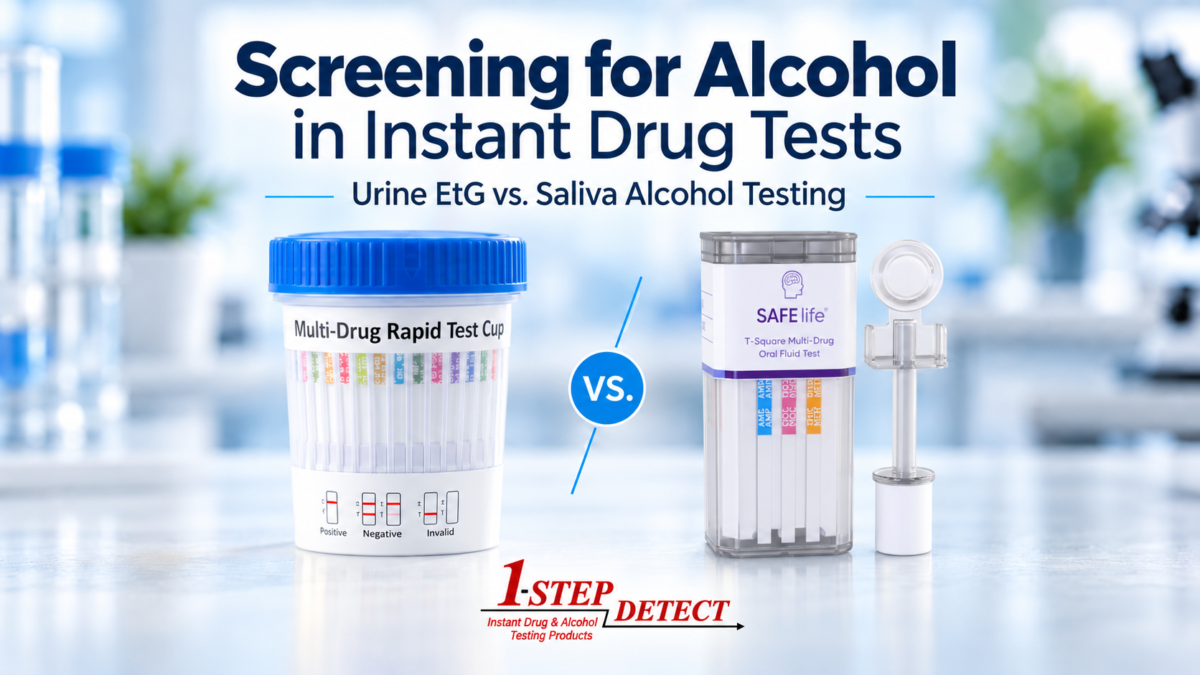
Urine EtG vs. Saliva Alcohol Detection Times
A simple comparison looks like this:
| Test | What is primarily being detected? | Approximate detection window |
|---|---|---|
| Urine EtG | Ethyl glucuronide, an alcohol metabolite | Often about 24–72 hours, potentially longer in some circumstances |
| Saliva alcohol | Alcohol/ethanol in oral fluid | Generally recent use, up to around 24 hours |
These are approximate ranges.
No instant alcohol test can tell you exactly when a person consumed alcohol simply from a positive result.
Why Would I Choose a Urine EtG Test?
The major advantage is obvious:
A Much Longer Lookback Period
If you want to know whether someone may have consumed alcohol during the previous few days, EtG provides much more useful information than a saliva alcohol screen.
That can be valuable for programs where abstinence or alcohol use between scheduled tests is important.
A saliva test might already be negative by the time testing occurs.
An EtG urine test may still identify the metabolite.
EtG Can Be Added to Multi-Panel Drug Tests
Another major advantage is that EtG does not necessarily require a separate test.
Several expanded urine drug-test cups available from 1-Step Detect contain an ETG panel alongside numerous other drugs.
That means one urine specimen can potentially screen for alcohol exposure while also screening for substances such as fentanyl, cocaine, marijuana, methamphetamine, opiates, benzodiazepines, kratom, K2, ketamine, and others depending on the configuration.
For programs already using urine drug-test cups, adding EtG to the panel can therefore be very convenient.
What Are the Limitations of Urine EtG Testing?
The longer detection window can also be a disadvantage depending on your objective.
A positive EtG result does not establish current impairment.
Someone could potentially test positive for EtG despite no longer having meaningful alcohol circulating in their system.
EtG therefore should not be interpreted like a breathalyzer result.
Its purpose is primarily to provide evidence of recent alcohol exposure, not to determine whether someone is currently intoxicated.
Organizations should also understand that incidental alcohol exposure can complicate highly sensitive EtG testing. Policies and interpretation procedures should therefore be established carefully, particularly when testing outcomes carry significant consequences.
Are Instant Urine EtG Tests CLIA-Waived?
This is an important distinction for customers purchasing alcohol tests.
There is currently no CLIA-Waiver for instant urine EtG tests, regardless of manufacturer. Do not assume that a urine cup is CLIA-Waived simply because some of its other drug panels may commonly appear on CLIA-Waived devices.
This is a common misconception by many consumers.
Always verify the classification of the exact configuration you are purchasing.
What About CLIA-Waived Saliva Alcohol Testing?
This is where saliva provides an important option.
Certain saliva alcohol tests are CLIA-Waived.
A good example is:
ALCO-Screen Saliva Alcohol Screening Test
The ALCO-Screen is listed as both CLIA-Waived and FDA 510(k) cleared. It uses saliva to provide a rapid semi-quantitative estimate of alcohol concentration.
This can be a particularly useful option for organizations that need a waived rapid alcohol screen but do not need the longer EtG detection window.
ALCO-Screen estimates alcohol levels at the time of testing rather than looking several days backward for an alcohol metabolite.
Saliva Does NOT Automatically Mean CLIA-Waived
This is another distinction worth emphasizing.
It would be incorrect to assume:
“It is a saliva test, so it must be CLIA-Waived.”
That is not how device classification works.
CLIA status applies to the specific test device and configuration.
Some saliva alcohol tests may be waived.
Other saliva tests are not.
Always check the exact product and confirm that it fits your classification needs before purchasing.
Urine EtG Testing Options From 1-Step Detect
For customers who want the longer alcohol detection window associated with EtG, 1-Step Detect currently offers several options.
ETG Single-Panel Urine Dip Test
If alcohol is the only substance you need to screen for, a single-panel EtG dip can be the simplest solution.
The ETG (Alcohol) Single-Panel Drug Test Dip Cards (DET-114) screen a urine sample specifically for EtG.
Amazewell 12-Panel Cup With EtG
The Amazewell 12-panel configuration combines EtG with traditional drug panels and fentanyl, providing a broader screening option in a single urine cup.
SAFElife 12-Panel C-Cup With EtG & Fentanyl
This SAFElife Urine C-Cup includes EtG alongside amphetamine, benzodiazepines, buprenorphine, cocaine, MDMA, fentanyl, marijuana, methamphetamine, methadone, opiates, and oxycodone.
1-Step 14-Panel Cups With EtG
1-Step Detect offers multiple 14-panel urine configurations containing EtG.
One combines EtG with fentanyl, K2, Kratom, and other traditional drugs, while another combines ETG and fentanyl with an adulteration panel.
Expanded 17-, 20-, and 22-Panel Cups
Customers wanting a broader forensic drug-testing panel can also find EtG incorporated into larger configurations.
Current options include:
- 17-panel urine cup containing EtG, fentanyl, kratom, K2, 6-MAM, and other drugs
- 20-panel urine cup containing EtG, fentanyl, gabapentin, ketamine, kratom, K2, and other analytes
- 22-panel SAFElife T-Cup containing EtG alongside an extensive selection of traditional and newer forensic drugs
These products can be valuable when an organization wants alcohol screening to be just one part of a much broader instant drug screen.
Which Alcohol Test Should I Choose?
The easiest way to decide is to start with the question you are trying to answer.
Choose Urine EtG When:
- You want a longer alcohol detection window
- You are interested in alcohol consumption over roughly the previous one to three days
- You already use urine drug testing
- You want alcohol incorporated into a larger multi-panel drug test
- You do not require that particular EtG device to be CLIA-Waived
Consider Saliva Alcohol Testing When:
- You are primarily interested in very recent alcohol consumption
- You want a convenient, directly observed collection
- You do not want to collect urine
- A CLIA-Waived alcohol option such as ALCO-Screen fits your testing needs
EtG and Saliva Alcohol Tests Are Not Interchangeable
This may be the most important takeaway.
Someone purchasing a test labeled “Alcohol” should understand exactly what that test means.
With an instant urine panel labeled:
ETG / Alcohol
you are typically screening for the alcohol metabolite ethyl glucuronide.
With a saliva alcohol device, you are generally screening for alcohol itself in oral fluid.
The first can give you a much longer retrospective window.
The second is much more focused on recent alcohol presence.
Neither is automatically superior.
They simply provide different information.
Can a Drug Test Tell If Someone Is Drunk?
An instant alcohol screen should not automatically be interpreted as proof of impairment.
This is particularly important with EtG.
Because EtG may remain detectable well after ethanol has left the person’s bloodstream, an EtG-positive urine result does not mean the person is currently intoxicated.
Saliva alcohol screening is more closely associated with alcohol currently present, and ALCO-Screen is designed to estimate BAC from saliva. However, the manufacturer’s instructions specifically state that it should not be used to determine whether someone can legally operate a motor vehicle or heavy equipment, and positive screening results should be handled according to the applicable testing program.
The purpose of a rapid screen is to provide preliminary information.
Screening for Alcohol With 1-Step Detect
Alcohol testing does not have to be separate from the rest of your drug-testing program.
Depending on what you need to accomplish, 1-Step Detect offers both urine EtG testing and saliva alcohol testing options.
If you need a longer lookback period, an EtG urine panel may allow alcohol exposure to be detected for roughly 24–72 hours, sometimes longer depending on circumstances.
If you are primarily concerned with recent alcohol consumption, a saliva alcohol screen can provide a much shorter and more immediate testing window.
That is why it is always important to choose a test based not only on the substance listed on the panel but also on the specimen type, detection window, intended use, and classification of the exact device.
At 1-Step Detect, we offer options for organizations that need standalone alcohol testing as well as organizations that want alcohol incorporated into a broader instant drug-testing panel.
The question is not simply:
“Can I test for alcohol?”
The better question is:
“How far back do I need my alcohol test to look?”
Once you answer that, deciding between urine EtG and saliva alcohol testing becomes much easier.