Why Is My Drug Test Line So Faint? Does It Mean I’m Almost Positive?
One of the most common questions people have after using an instant drug test is:
“Why is this line so faint? Does that mean I’m almost positive?”
It is an understandable assumption.
One drug panel may have a dark red test line. Another may have a medium line. Then one strip may produce a line that is barely visible.
That can make someone think:
“There must be more of that drug in the sample.”
Or even:
“That should probably count as positive.”
For standard competitive instant urine drug tests, that is generally not how the result should be interpreted.
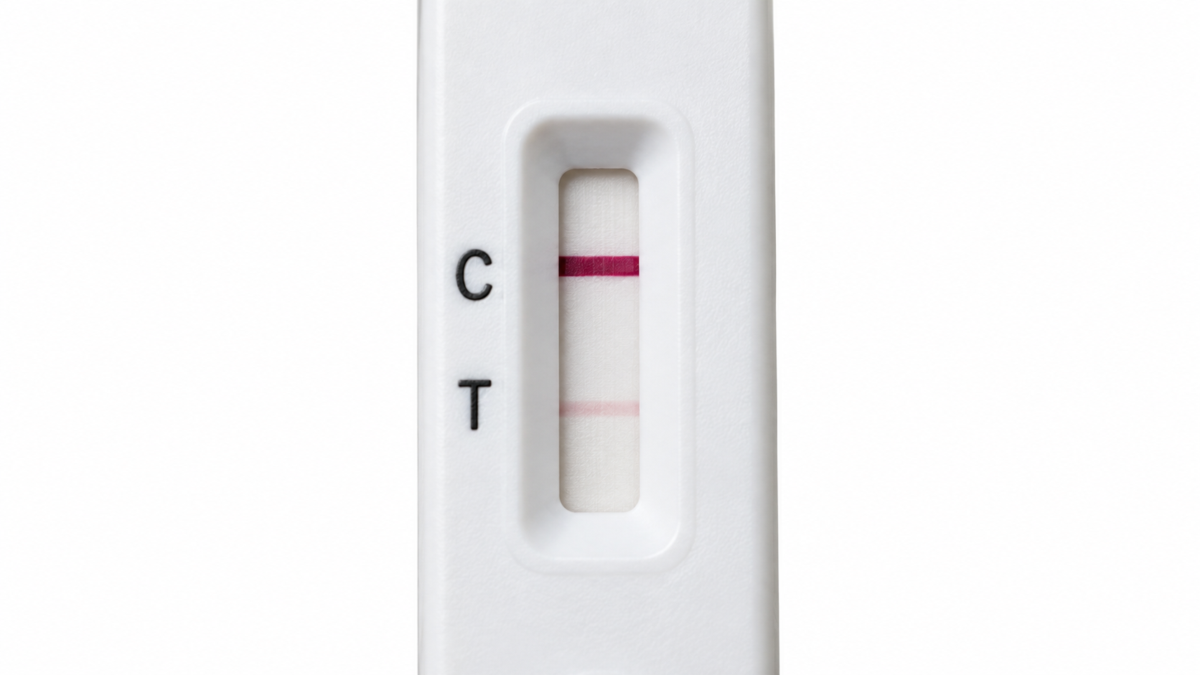
If a valid test line appears in the test region — even when the line is faint — the result is generally considered negative, provided the control line is present and the test is being interpreted within the manufacturer’s specified reading period.
Trusted regulatory sources of these devices explicitly state that any line appearing in the test region, regardless of its intensity and even when faint, is considered a negative result.
Most importantly:
A faint test line does not mean you are “almost positive.”
Instant drug tests are qualitative screening tests, not quantitative measurements. Their purpose is to provide a negative or preliminary positive result based on an assay cutoff — not to tell you how much drug is present based on how dark the line appears.
What Does a Faint Line on a Drug Test Mean?
Most instant urine drug-test strips contain two areas:
C — Control
T — Test
For the common competitive immunoassay format:
- Control line + test line = Negative
- Control line only = Preliminary/Presumptive Positive
- No control line = Invalid
The key point is that the test line does not have to match the control line in darkness.
It can be noticeably lighter. It can be very faint.
Source documentation states:
“Regardless of the color intensity,” a line in the test region is considered negative.
That includes faint lines.
So if you can clearly see a legitimate colored test line at the correct reading time, you generally should not reinterpret it as positive simply because it is lighter than the other lines.
Does a Faint Line Mean There Is Almost Enough Drug to Test Positive?
This is probably the biggest misconception surrounding instant drug tests.
People often imagine the test working like this:
Dark line = absolutely no drug
Medium line = a little drug
Faint line = almost positive
No line = positive
That is not a valid way to quantify an instant drug screen.
Drugs-of-abuse rapid tests of this type are classified as qualitative tests. A qualitative test tells you whether the screening result meets the criteria for negative or preliminary positive; it does not provide an actual numerical concentration.
A quantitative laboratory test is different. Quantitative testing can report an actual measured concentration.
Your instant cup or dip card is not doing that.
Therefore, you cannot reliably look at two test lines and conclude:
“This person has twice as much THC as that person.”
You also cannot conclude:
“That line is very faint, so they were only a few ng/mL away from failing.”
The test is not designed to provide that information visually.
But Drug Tests Do Have Cutoff Levels — So How Does That Work?
Instant drug tests do operate around established cutoff concentrations.
A cutoff is essentially the concentration at which that particular assay differentiates between a negative screen and a preliminary positive screen.
But there is an important difference between:
the assay using a cutoff
and
the darkness of the line providing a quantitative measurement of that cutoff.
Those are not the same thing.
Drug-testing devices are calibrated around specified cutoff concentrations, but the results are still reported qualitatively.
A negative result therefore does not necessarily mean:
“There are absolutely zero molecules of this substance in the urine.”
It means the device produced a negative screening result according to its assay and cutoff.
Reliable sources specifically note that drug-test results can be negative even when drug use occurred, including when testing occurs outside the detection period or other factors affect whether the substance is detected.
That still does not turn line darkness into a drug-concentration gauge.
Why Do Faint Lines Happen?
To understand why different lines can have different appearances, it helps to understand what is happening inside the test strip.
Most instant urine drug tests use a competitive lateral-flow immunoassay.
Inside each strip are specialized antibodies and drug conjugates associated with the particular drug or metabolite being screened.
Urine moves along the strip through capillary action.
In a negative specimen, the labeled antibodies are able to interact with the immobilized drug conjugate in the test area, creating a visible test line.
When enough of the target drug or metabolite is present, it competes for those antibody-binding sites. That competition prevents the test line from developing, producing the preliminary positive pattern.
Because this is a chemical reaction occurring on a lateral-flow membrane, there is no requirement for every negative test line to develop at exactly the same intensity.
Different Drugs Use Different Reagents
This becomes particularly noticeable on multi-panel drug tests.
A 12-panel cup is not simply performing the same identical test twelve times.
Each strip is designed to detect a different drug or metabolite and uses assay chemistry specific to that analyte.
For example, the chemistry used for:
- THC
- Cocaine
- Amphetamine
- Methamphetamine
- Benzodiazepines
- Opiates
- Fentanyl
is not identical.
Different antibodies, conjugates, cutoff concentrations, and assay characteristics are involved.
That is why it is completely possible to look at a multi-panel cup and see:
COC — dark line
AMP — dark line
MET — medium line
BZO — faint line
THC — very faint line
If all of those legitimate test lines appear according to the device’s instructions, they are generally interpreted the same way:
Negative.
Do not try to rank them based on darkness.
Don’t Compare One Drug Panel to Another
Another common mistake is looking across an entire multi-panel cup and expecting every line to be identical.
They probably will not be.
You should not conclude:
“Every line is dark except THC, so something must be wrong with the THC result.”
Each drug panel should be interpreted according to its own presence or absence of a valid test line.
The important question is not:
“Is the THC line as dark as the cocaine line?”
It is:
“Is a valid THC test line present?”
If it is, and the test has otherwise developed correctly, the result should be interpreted according to the manufacturer’s negative-result criteria.
Wait the Full Reading Time Before Deciding
Timing is extremely important with lateral-flow drug tests.
One of the easiest mistakes to make is checking the cup immediately after collection and attempting to interpret results before the test has fully developed.
Imagine watching the strips for the first minute.
Several lines develop immediately.
One does not.
You might think:
“That panel is positive.”
Then two or three minutes later, a faint test line begins appearing.
This is why you should not try to beat the test’s timer.
For many rapid urine drug-test devices, five minutes is the instructed reading time.
If your device says five minutes, wait the entire five minutes.
Use an actual timer.
Do not estimate.
Do not declare a preliminary positive at 60 seconds because one test line has not developed as quickly as the others.
Let the assay complete according to its instructions.
Don’t Read a Drug Test Too Late Either
Reading the test too early can cause problems.
So can reading it too late.
Every drug test has an approved interpretation window specified by its manufacturer.
Results observed outside that window should not automatically be treated as valid.
Manufacturers and regulators specifically advise users to read rapid drugs-of-abuse tests within the number of minutes stated in the test instructions.
Some devices say:
Read at 5 minutes. Do not interpret after 10 minutes.
Others may specify a different period.
Therefore, the correct rule is not:
“Every drug test must be ignored after exactly ten minutes.”
The correct rule is:
Read the exact package insert for the test you are using.
If it says:
Read at five minutes and do not read after ten
then five to ten minutes is your relevant window.
If it gives another window, follow that.
Do not leave a cup sitting on a desk for an hour and then attempt to reinterpret changes that occurred long after its approved reading period.
Why Does the Control Line Look Darker?
The control line and test line have different jobs.
The control line primarily demonstrates that the testing procedure worked properly.
Its presence helps show that specimen migrated through the device and that the test functioned as expected.
The test line is part of the competitive reaction used to screen for the particular drug or metabolite.
Because the two lines serve different purposes, there is no reason they must match visually.
A dark control line beside a much lighter test line can still represent a completely valid negative result.
What If I Can Barely See the Test Line?
There is an important difference between:
“The line is extremely faint, but I can clearly see it.”
and:
“I genuinely can’t determine whether a line exists.”
If you can clearly see a legitimate colored line in the test region within the proper reading window, drug-test instructions support interpreting even a faint line as negative.
If the result is genuinely ambiguous, however, don’t guess.
When in Doubt, Retest
If you cannot confidently determine whether a test line actually formed, one practical option is to repeat the test with a new device.
This is especially appropriate when you suspect:
- Insufficient specimen
- Improper test procedure
- Improper storage
- An expired device
- Poor specimen migration
- An invalid control result
- A genuinely unreadable result
Regulatory bodies note that accuracy can be affected by how a test was performed, how the test or specimen was stored, other substances present in the specimen, and whether the device remained within its expiration period.
If you repeat a test, use a fresh device and follow the instructions carefully.
What If the Control Line Doesn’t Appear?
That is different from a faint test line.
If the required control line does not appear, the test should generally be considered invalid.
You should not call it negative.
You should not call it positive.
Repeat the test with a new device according to its instructions.
Should I Just Retest a Positive Result Until I Get a Negative One?
No.
“Retest when the result is genuinely unreadable or invalid” is very different from repeatedly testing a legitimate preliminary positive until a preferred result appears.
If the test has:
- A valid control line
- No test line
- Been read during the correct interpretation period
- Been performed according to its instructions
then the device has produced a preliminary positive screening result.
When a definitive answer is required, the appropriate next step may be laboratory confirmation, not repeatedly performing instant tests.
Manufacturers and regulators emphasize that rapid drugs-of-abuse tests produce preliminary results and recommends laboratory confirmation before taking serious action based on a positive screening result.
Regulators similarly state that preliminary positive results should be confirmed using a more specific analytical method such as GC/MS or LC/MS when confirmation is necessary.
Can a Negative Drug Test Still Contain Some of the Drug?
Potentially, yes.
A negative screening result should not be interpreted as proof that absolutely no amount of a substance exists in the specimen.
Instant tests are designed around their particular detection thresholds and detection windows.
That is an important distinction:
Negative does not necessarily mean zero.
But once again:
A faint line does not provide a quantitative estimate of how much is present.
Both of those statements can be true at the same time.
Why Are Drug Tests the Opposite of Some Other Rapid Tests?
Part of the confusion comes from people’s experience with pregnancy tests and other lateral-flow devices.
With some familiar tests:
Two lines = Positive
That causes people to look at a drug test and assume a second line must mean the same thing.
But standard competitive urine drug immunoassays work differently.
For these devices:
Negative
Control line + Test line
Preliminary Positive
Control line only
Invalid
No required control line
That is because of the competitive assay design.
When the drug is absent or below the cutoff, labeled antibody is available to bind at the test area, forming a visible line.
When enough drug is present, the drug competes for the antibody-binding sites and prevents that line from forming.
So with this type of drug test:
A line is good.
Even a faint one.
Best Practices for Avoiding Faint-Line Confusion
Most confusion can be eliminated by following a consistent testing procedure.
- Check the expiration date before testing.
- Store tests according to the manufacturer’s directions.
- Collect an adequate specimen.
- Follow the exact test procedure.
- Start a timer immediately when instructed.
- Wait the full specified development period — commonly five minutes for many devices.
- Confirm that the control line developed.
- Look for the presence or absence of the test line — not how closely its darkness matches the control.
- Count a valid faint test line as negative when the device’s instructions specify that faint lines count.
- Do not continue interpreting the result beyond the manufacturer’s stated reading window.
- Repeat the test with a fresh device if the result is invalid or genuinely unreadable.
- Use laboratory confirmation when a definitive result is required following a preliminary positive.
The most important step is simple:
Read the instructions for the exact drug test you are using.
Even if you have performed hundreds of drug tests before, manufacturers and devices can differ.
Frequently Asked Questions About Faint Drug-Test Lines
Is a very faint line on a drug test negative?
For standard competitive instant urine drug tests, yes, generally. Device instructions state that any visible test line, even when faint, should be interpreted as negative when the control line is present and the result is read properly.
Does a faint line mean the person barely passed?
No. These tests are qualitative rather than quantitative. Line darkness is not designed to tell you how close someone’s concentration is to the test cutoff.
Why is my THC line fainter than the other drug lines?
Different analytes use different assay chemistry, reagents, and cutoff concentrations. Test-line intensity does not need to be identical between panels.
Should I wait five minutes before reading a drug test?
Many instant urine tests specify approximately five minutes and some products exist with explicit five-minute read instructions. However, you should always follow the timing printed in the instructions for your exact test.
Can a test change if I leave it sitting too long?
Results should only be interpreted within the manufacturer’s approved reading period. Regulatory bodies advise following the test’s specified timing because rapid results must be visually interpreted within the designated number of minutes.
What if I’m not sure whether I see a line?
If the result is genuinely ambiguous, repeat the test using a fresh device and follow the instructions carefully rather than guessing.
What if there is no control line?
The test is invalid and should generally be repeated with a new device.